

Tree-Climbing Lions in Uganda |Where to See Africa's Most Extraordinary Lions
This is Ishasha. And nothing quite prepares you for it. Uganda's tree climbing lions are among the rarest and most talked-about wildlife spectacles in Africa a genuine behavioural anomaly that has drawn photographers, naturalists, and safari travellers from across the globe to the remote southern sector of Queen Elizabeth National Park. This guide curated by the specialists at Savannah Explore Africa covers everything you need to know to find them, understand them, and photograph them at their extraordinary, arboreal best.
Uganda's tree-climbing lions are found exclusively in the Ishasha Sector of Queen Elizabeth National Park one of only two locations in Africa where this behaviour occurs consistently. The Ntungwe River fig tree corridor is the most productive area for sightings. Game drives are available year-round, with the dry season (June–September and December–February) offering the highest visibility. A dedicated Ishasha safari starts from $1,200 per person for a 3-day itinerary.
Tree Climbing Lions in Uganda:
Where to See Africa's Most
Extraordinary Lions
The Ishasha Sector Uganda's Most Celebrated Wildlife Secret
Updated June 2026 ◆ Ishasha Sector · Queen Elizabeth National Park · Game Drive Tips · Safari Combinations
You expect a lion on the ground. Every instinct, every safari story, every wildlife documentary has prepared you for a lion as a creature of the grass low, muscular, sovereign of the plain. And then you look up.
Twenty feet above the Savannah floor, draped across the broad limbs of an ancient fig tree with the unhurried ease of a cat entirely at home, a fully grown lioness regards you with absolute calm. Below her, the rest of the pride is distributed across the branches like living sculptures paws hanging, tails swaying, expressions of magnificent indifference directed at the world beneath them.
This is Ishasha. And nothing quite prepares you for it.
Uganda's tree-climbing lions are among the rarest and most talked-about wildlife spectacles in Africa a genuine behavioural anomaly that has drawn photographers, naturalists, and safari travellers from across the globe to the remote southern sector of Queen Elizabeth National Park. This guide curated by the specialists at Savannah Explore Africa covers everything you need to know to find them, understand them, and photograph them at their extraordinary, arboreal best.
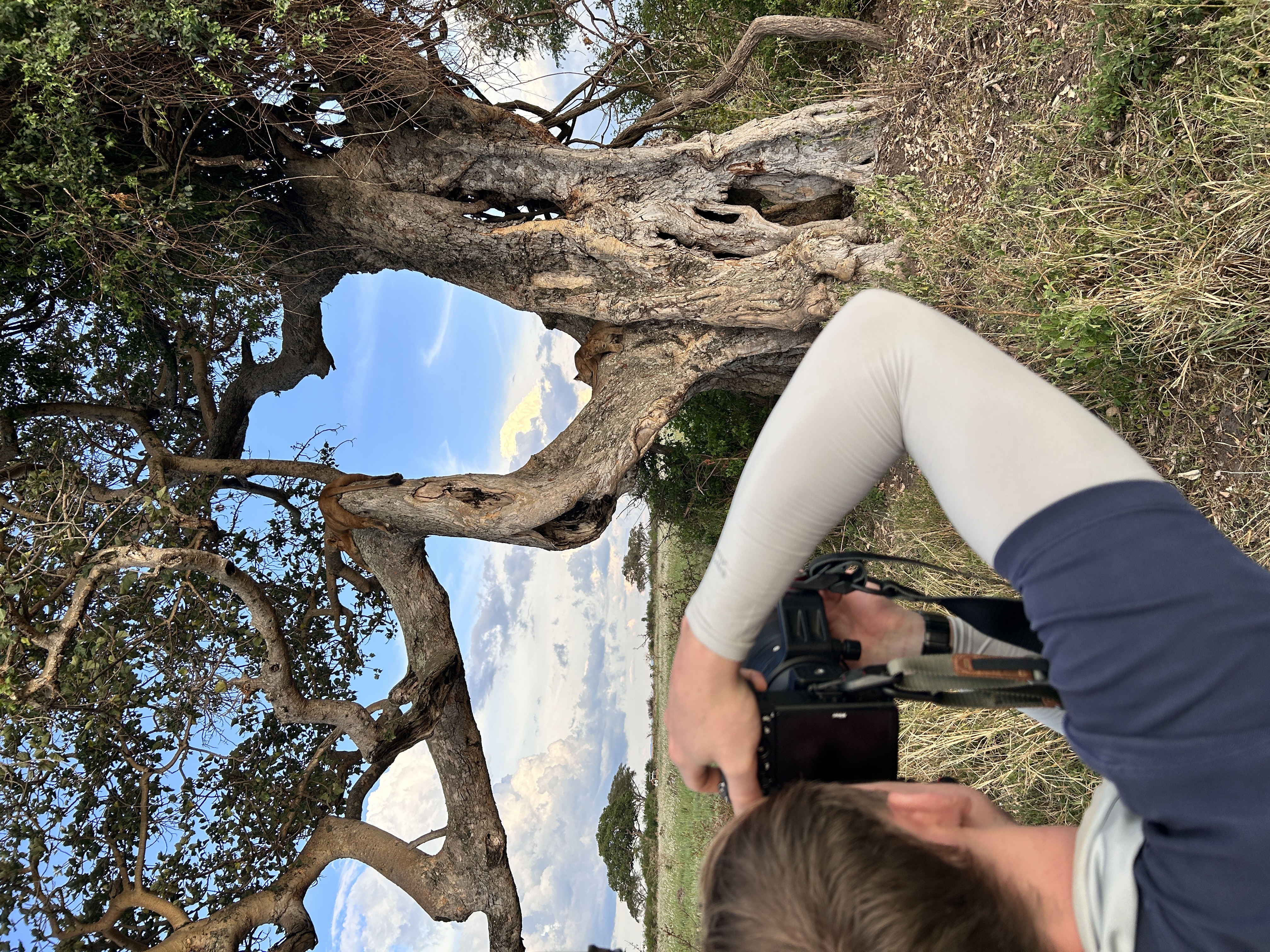
"Seeing a lion in the Savannah is thrilling. Seeing one sleeping twenty feet above you in the branches of a fig tree is something else entirely a sighting that rewrites what you thought a safari could be."
What Are Tree-Climbing Lions?
Tree-climbing lions are not a subspecies, nor a genetic variant. They are African lions (Panthera leo) identical in biology to every other lion on the continent who have developed and passed down a remarkable behavioural adaptation: the habitual use of trees as resting, observing, and socialising platforms.
Across Africa's vast lion range, the vast majority of individuals spend their lives entirely at ground level. Trees are for leopards, for baboons, for birds. Lions, conventional wisdom insists, do not climb. The Ishasha pride has spent generations proving conventional wisdom wrong.
What makes Uganda's tree-climbing lions particularly extraordinary is the consistency and apparent cultural transmission of the behaviour. Young cubs are observed watching adults ascend before attempting the climb themselves a pattern of social learning that suggests the habit is not accidental, but deliberately acquired and passed between generations within the pride. A cub born in Ishasha learns to climb trees the way a cub born in the Serengeti learns to hunt wildebeest: by watching, attempting, and ultimately mastering.
2
Known Tree-Climbing Lion Populations in Africa
20 ft+
Height Lions Have Been Observed Resting
Ishasha
The World's Most Reliable Sighting Location
Only two populations of lions in Africa display this behaviour with any consistency: the Ishasha pride of Queen Elizabeth National Park in Uganda, and a population in the Lake Manyara region of Tanzania. Of these two, Ishasha offers significantly more reliable sighting opportunities and does so within one of East Africa's most scenically dramatic landscapes.
Why Do Ishasha's Lions Climb Trees?
This is the question every visitor asks and one that science has not yet definitively answered. Several compelling theories have been advanced, and most researchers believe the behaviour is likely multi-causal: a combination of practical advantages that collectively make the trees worth the effort of climbing.
Theory 01
Escaping Ground-Level Insects
The Ishasha plains are notorious for tsetse flies and biting insects that congregate at ground level during the heat of the day. The elevated position of a fig tree branch even a few metres above the grass dramatically reduces insect density, offering the lions relief unavailable on the savannah floor.
Theory 02
Superior Territorial Vantage
From fifteen to twenty feet above the plain, a lion commands an extraordinary view of its territory. Prey movements, rival predators, and approaching threats are visible at far greater distances than ground-level observation allows a meaningful strategic advantage for a pride managing a large home range.
Theory 03
Regularisation & Airflow
Uganda's savannah temperatures peak in the early afternoon precisely the hours when the Ishasha lions are most reliably found in the trees. The elevated canopy position captures airflow unavailable at ground level, and the dense shade of the fig tree provides a significantly cooler micro-climate than the exposed grass below.
Theory 04
Learned Cultural Behaviour
Perhaps the most fascinating explanation of all: tree climbing in Ishasha appears to be a culturally transmitted behaviour a learned tradition passed from generation to generation within the pride. Cubs observe adult lions ascending, attempt the climb themselves, and in time teach their own offspring. The trees have become part of what it means to be an Ishasha lion.
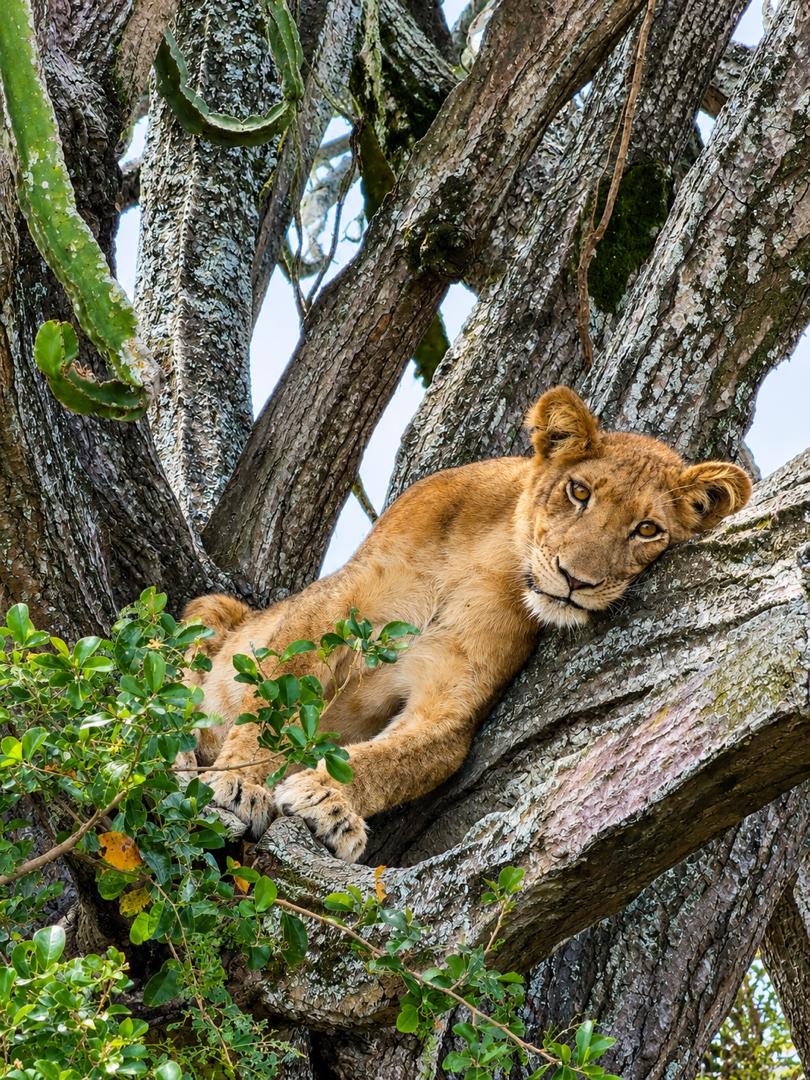
The truth is almost certainly that all four factors contribute and that the Ishasha lions have, over generations, arrived at a set of behaviours uniquely suited to their particular landscape. This adaptive intelligence is precisely what makes them so compelling to observe and study.
Where to See Tree-Climbing Lions: The Ishasha Sector
All reliable tree-climbing lion sightings in Uganda occur within the Ishasha Sector the remote southern division of Queen Elizabeth National Park, positioned near the border with Bwindi Impenetrable Forest in southwestern Uganda.
Ishasha is separated from the main body of Queen Elizabeth National Park by roughly 60 kilometres of park road, and this geographical distance has preserved something precious: a landscape that feels genuinely unhurried, uncommercialised, and wild. Where the northern sectors of QENP draw moderate visitor traffic, Ishasha remains comparatively quiet a characteristic that deeply enhances the quality of the wildlife experience.
The sector's landscape is a study in contrasts: open savannah grassland punctuated by ancient riverine woodland, scattered acacia, and most importantly, the enormous strangler figs that the lions have made their own. The Ntungwe River runs through the sector, drawing wildlife to its banks and providing the dense fig tree corridors where the lions are most consistently found.
The Ntungwe River fig tree corridor is the single most productive area for tree-climbing lion sightings experienced guides check these trees first on every game drive
The sector's low visitor density means sightings unfold without the vehicle congestion common at more famous lion-viewing destinations across Africa
Open savannah beyond the river supports exceptional general game viewing alongside the lion search
The remoteness of Ishasha contributes significantly to the authenticity of the experience this is safari as it was always meant to feel
Access from Bwindi Impenetrable Forest is straightforward, making Ishasha a natural extension of any gorilla trekking itinerary
Wildlife Beyond the Lions: Ishasha's Full Safari Canvas
The tree-climbing lions are Ishasha's headline act but the sector's wildlife offering extends far beyond a single extraordinary species. A full game drive here reveals an ecosystem of remarkable diversity and density.
African Elephant
Large herds roaming the savannah and riverine woodland
Cape Buffalo
Thousands throughout the sector a primary lion prey species
Uganda Kob
Abundant antelope and the lions' most frequently hunted prey
Leopard
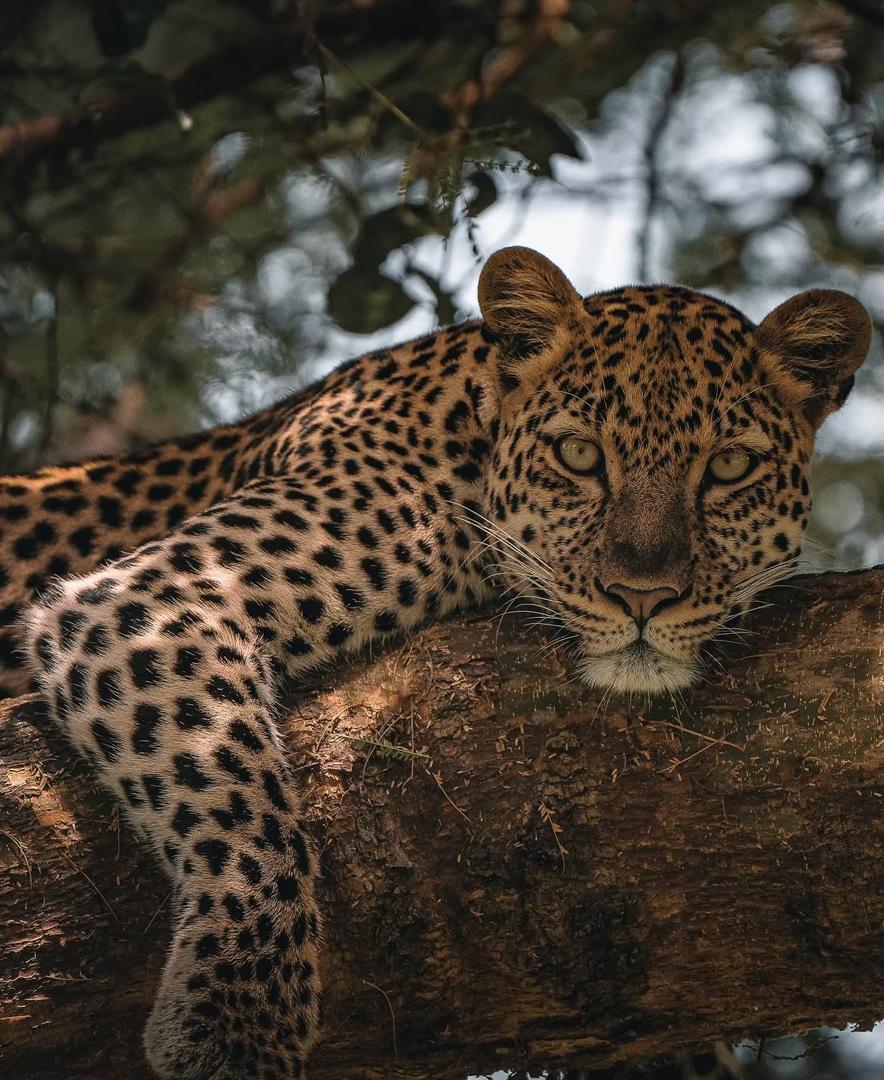
Elusive but present occasionally spotted in riverine woodland
Topi
Commonly seen grazing across open grassland at dusk
Exceptional Bird life
Hundreds of species including African fish eagle and martial eagle
The presence of hyena clans particularly active during the cooler early morning and evening hours adds a layer of predator-prey drama to game drives that extends well beyond the lion search itself. Ishasha rewards patient, unhurried game driving: the landscape reveals itself slowly, generously, and entirely on its own terms.
Best Time to See Tree-Climbing Lions in Ishasha
The tree-climbing lions of Ishasha can be encountered in any month the behaviour is not seasonal, and the pride uses the trees year-round. However, certain periods offer superior game drive conditions, better photographic light, and higher sighting reliability.
Peak Season
Dry Season
June – September & December – February
Short grass improves visibility lions in trees easier to spot against open canopy
Game drive tracks accessible throughout the entire sector
Clear skies and golden light optimal conditions for photography
Wildlife concentrates around the Ntungwe River, increasing encounter density
Shoulder Season
Green Season
March – May & October – November
Lush, dramatically green savannah extraordinarily photogenic landscapes
Fewer visitors the sector at its most private and intimate
Potential lodge rate reductions of 15–25%
Newborn Uganda kob calves attract heightened lion hunting activity
For lion sightings specifically, the dry season offers a practical advantage: with grass cut low, spotting a pride distributed across the upper branches of a fig tree becomes considerably easier. During the green season, the same trees surrounded by tall grass and dense foliage require a more experienced eye to locate. That said, our guides know these trees intimately, and sighting rates remain high in both seasons.
What to Expect on an Ishasha Game Drive
Game drives in Ishasha follow the rhythms of the animals themselves beginning before dawn and returning at the hour when the savannah light turns gold. The lions are most likely to be in the trees during the heat of the day, making a mid-morning game drive departing around 6:30am the most productive window for arboreal sightings.
The Morning Drive
Departing as the sky begins to pale, your guide navigates first toward the Ntungwe River corridor the heart of the tree-climbing lions' territory. Radio communication with other guides in the sector, combined with an intimate knowledge of the pride's preferred fig trees, means the search is focused and purposeful rather than aimless. When the lions are located often announced by nothing more dramatic than a dangling paw spotted through binoculars the vehicle positions itself with care.
The Encounter
What awaits is unlike any other lion sighting in Africa. The pride is distributed across multiple branches of the same tree some sleeping, some watching, one perhaps descending with the slow, deliberate movements of a large cat navigating unfamiliar terrain. The cubs, inevitably, are the most entertaining: half-committed to descending, half-committed to following their mother back up, entirely committed to communicating their uncertainty at considerable volume.
You may spend thirty minutes at the tree. You may spend two hours. The encounter dictates its own duration and every visitor we have ever taken to Ishasha has described the time as far too short.
The Evening Drive
Afternoon game drives departing around 3:30pm and running until dusk offer a different but equally compelling experience. As temperatures drop, the lions descend and become active: grooming, socialising, and beginning the territorial movements that precede the night's hunting. The light at this hour, falling golden across the savannah, is among the most beautiful in Uganda.
Photography Tips: Capturing Tree-Climbing Lions
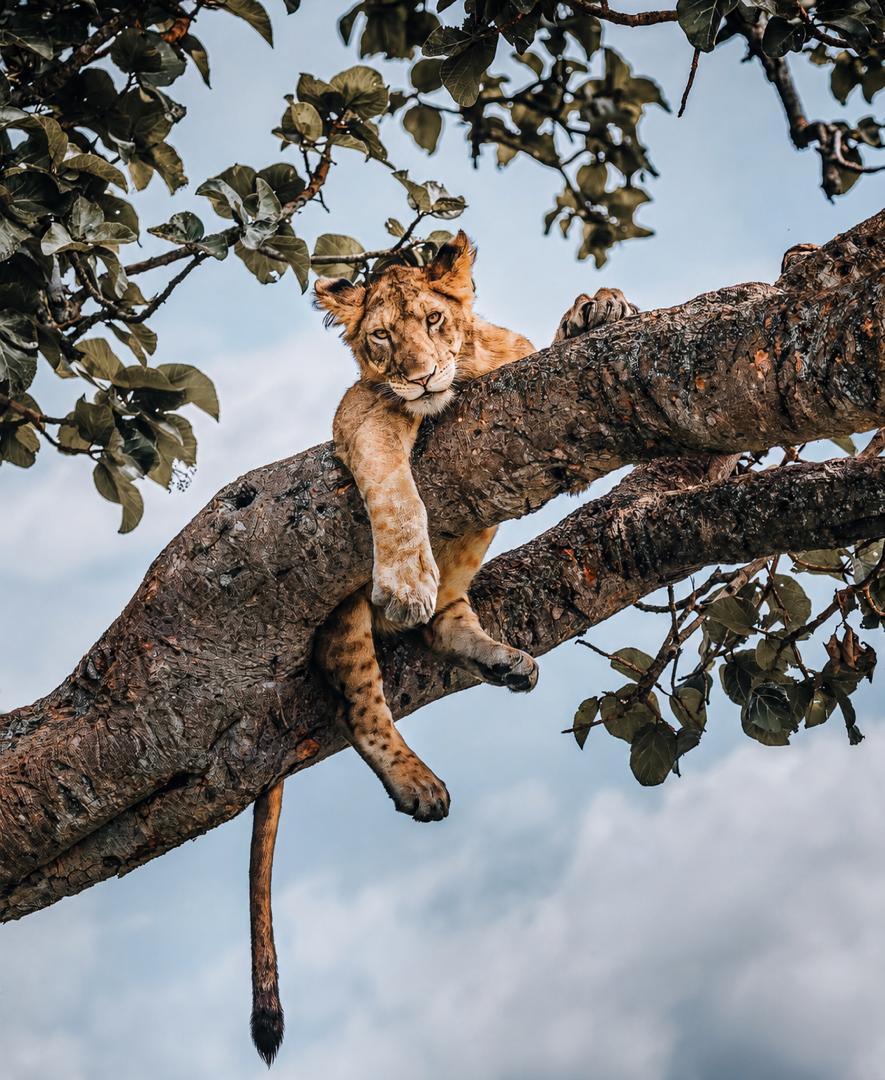
The visual opportunity presented by tree-climbing lions is genuinely unique in African wildlife photography a fully grown lion, backlit by morning sky, sprawled across a branch with the savannah stretching to the horizon below. With the right preparation, images of extraordinary quality are entirely achievable.
◆Use a telephoto lens of 200–500mm the lions are in the trees, not always at close range
◆Shoot during the golden hour dawn and dusk light transforms the fig trees into extraordinary backdrops
◆Include the tree in wide-angle establishing shots the scale relationship between lion and branch is part of the story
◆Set a fast shutter speed (1/800s+) for movement descending lions move quickly and unpredictably
◆Focus on the eyes a lion's gaze from twenty feet above is among the most powerful images in wildlife photography
◆Capture the cubs their hesitant climbing attempts are among the most endearing moments on any safari
◆Bring extra memory cards and batteries extended encounters mean extended shooting
◆Ask your guide to position the vehicle for the best light direction before settling in
Combining Ishasha with Uganda's Other Great Experiences
One of Uganda's most compelling advantages as a safari destination is the geographical proximity of its greatest wildlife experiences. Ishasha sits within easy reach of Bwindi Impenetrable Forest, Kibale Forest, and Lake Mburo National Park making multi-destination itineraries that combine tree-climbing lions with gorilla trekking, chimpanzee tracking, and walking safaris entirely practical within a single journey.
Sample 5-Day Ishasha & Gorilla Safari
Day 1
Arrival & Transfer to Ishasha Fly or drive from Entebbe to the Ishasha Sector of Queen Elizabeth National Park. Afternoon game drive upon arrival first introduction to the savannah landscape and its remarkable inhabitants.
Day 2
Full Day in Ishasha Morning and afternoon game drives dedicated to the tree-climbing lion search. Extended time in the Ntungwe River corridor with the full Ishasha wildlife canvas: elephant, buffalo, Uganda kob, topi, and the lions in their fig tree sanctuary.
Day 3
Transfer to Bwindi Scenic drive through southwestern Uganda's highlands to Bwindi Impenetrable Forest. Afternoon at leisure briefing with rangers on the following morning's gorilla trek.
Day 4
Mountain Gorilla Trekking The defining encounter: one protected hour with a habituated mountain gorilla family in the ancient forest of Bwindi. Afternoon recovery and reflection at the lodge.
Day 5
Return to Entebbe Optional Mabamba Swamp shoebill excursion en route to the airport. Departure with two of Africa's most extraordinary wildlife encounters complete.
Itinerary Option | Duration | Estimated Cost Per Person |
|---|---|---|
Ishasha Lions Only Weekend Safari | 3 days | $1,200 – $2,500 |
Ishasha + Gorilla Trekking | 5 days | $3,500 – $6,500 |
Ishasha + Gorilla + Chimpanzee | 7 days | $5,500 – $9,000 |
Grand Uganda Circuit (incl. Murchison Falls) | 10 days | $8,000 – $15,000 |
Frequently Asked Questions
Where exactly can I see tree-climbing lions in Uganda?
All reliable tree-climbing lion sightings in Uganda occur in the Ishasha Sector of Queen Elizabeth National Park specifically in and around the Ntungwe River fig tree corridor in the sector's southern reaches. This is the only location in Uganda where tree-climbing lion behaviour is observed consistently, and one of only two such locations in all of Africa. Savannah Explore Africa's guides know the Ishasha pride's favoured trees intimately and focus every game drive accordingly.
Are tree-climbing lion sightings guaranteed?
No wildlife encounter can ever be guaranteed this unpredictability is fundamental to the authenticity of the safari experience. That said, Ishasha's sighting rates are among the highest for any specific wildlife behaviour in East Africa. Our experienced guides monitor pride movements continuously, and the vast majority of guests who spend two or more game drives in the sector encounter the lions in the trees. We recommend a minimum of two game drives morning and afternoon to maximise your probability of a sighting.
Why do the Ishasha lions climb trees?
The precise motivation remains an area of active scientific enquiry and part of what makes Ishasha's lions so fascinating is that they resist a simple explanation. The most widely accepted theories attribute the behaviour to a combination of factors: escape from ground-level insects (particularly tsetse flies), regularisation through elevated airflow and shade, improved territorial visibility, and perhaps most intriguingly cultural transmission across generations within the pride. The lions climb trees because their mothers climbed trees, and their mothers before them.
How does Ishasha compare to Tanzania's Lake Manyara for tree-climbing lions?
Both locations offer the extraordinary spectacle of arboreal lions but they differ significantly in sighting reliability and safari context. Ishasha's lions are observed in trees with far greater consistency than Lake Manyara's population, which climbs trees considerably less frequently. Ishasha also benefits from substantially lower visitor numbers, creating a more private and immersive encounter. For visitors specifically seeking tree-climbing lions as a primary safari objective, Ishasha is unambiguously the superior destination.
Can I combine Ishasha with gorilla trekking in one trip?
This is one of our most popular and most rewarding itinerary combinations and one that Uganda's geography makes uniquely practical. Ishasha sits approximately two to three hours by road from Bwindi Impenetrable Forest, meaning a seamless transition from tree-climbing lions to mountain gorilla trekking within a single itinerary is entirely achievable. Many of our clients describe the Ishasha-Bwindi combination as the most extraordinary two to three days of wildlife experience they have ever had on any continent.
What is the best time of day to see the lions in the trees?
The lions are most reliably arboreal during the warmest hours of the day typically from mid-morning (around 9:00am) through to mid-afternoon. A game drive departing at 6:30am, exploring the broader sector in the cool early hours, and arriving at the fig tree corridor as the temperature rises, provides the optimal combination of general wildlife viewing and tree-climbing lion sighting probability. Evening drives offer the additional reward of observing the pride descend and become active as the heat dissipates.
Savannah Explore Africa
See the Lions That Look Down at the World
The Ishasha Sector is one of Africa's great wildlife secrets and one that belongs on every Uganda itinerary. Let our specialists craft an experience around it that you will never forget.
Begin Your Journey
Your story starts
in East Africa.
Tell us your dates, your dream, and how you like to travel. We will design something extraordinary, only for you.